Subscribe to receive the latest posts

Did you know that in Greek, the original language of the New Testament, two different words are used to refer to God’s speaking? They are logos and rhema. Understanding the meaning of these words can help us know and experience God in a deeper way.
Today we’ll read verses and notes from the New Testament Recovery Version to see the importance of both logos and rhema in our Christian life.
In Greek, logos is used to refer to the constant, objective word. It generally refers to the word of God recorded in the Bible. It’s truly amazing that God’s speaking was written down and preserved, and because of this, we can read it today.
God’s Word reveals who God is to us. It reveals His acts, His ways, what He desires, what He loves, and what He hates. By reading the Bible, we can learn about God's way of salvation and His plan for mankind.
Without the logos, mankind would be in utter darkness, unable to know what God wants and what the meaning of human life is. So if we want to know God, we must read the Bible, the logos.
Rhema is the other Greek word used in the New Testament to refer to the word of God. Rhema refers to the instant, direct speaking of God to us. God’s personal speaking to us is precious. It’s by this speaking that we can know Him, not just objectively, but subjectively.
We all want God to speak to us personally. But how does that happen? Does God speak only to a particular class of Christians? No! God wants to have a personal relationship with every one of us, and a great part of that relationship depends on His speaking to us.
Now let's take a closer look at how we can experience the word of God as rhema.
So how does God personally speak to us? How can we be sure we have God’s genuine speaking? It would be easy for anyone to say, “Oh, God told me to do this or that.” But did He really?
We don’t want to be misled. It’s vitally important for us to realize that God uses the logos to speak rhema to us. God’s instant word always corresponds with and never contradicts His written Word.
For example, God’s Word clearly says that lying and stealing are sins. So any genuine speaking from God would never tell us to lie to someone or steal from them.
So if we want God’s instant speaking, we need to read the written Word. The more we read the written Word, even storing it up within us by praying with it, musing over it, and memorizing it, the more God can speak His rhema word to us in our daily life.
The rhema, the instant speaking of God, does many things in us. Let’s look at three of these—it guides us, imparts life to us, and washes us inwardly.
Now that we’ve seen how we can have God’s instant speaking, let’s look at an illustration of how that speaking can guide us in a particular situation. Let’s say you’re at work or school and something happens that makes you very upset. The more you think about it, the more bothered you are. As thoughts about it swirl in your mind, you begin to feel spiritually deadened.
Then Romans 8:6, a verse you had previously read, comes to you: “The mind set on the flesh is death, but the mind set on the spirit is life and peace.” Immediately you realize why you feel so dead and have no peace: you’ve been setting your mind on the flesh.
So you turn to the Lord and pray, “Lord Jesus, I don’t want to set my mind on the flesh. I set my mind on the spirit right now. Thank You, Lord, when my mind is set on my spirit, I have life and peace!”
As you set your mind on the spirit, you’re saved from being consumed by your negative thoughts, and you’re ushered into enjoying life and peace from God. The Lord used the constant word (logos) that you had previously read in Romans 8 to speak an instant, personal word to you (rhema) in your particular situation. The Lord’s instant speaking strengthened you to turn to Him, and you experienced life and peace.
In addition to guiding us in particular situations, the rhema word of God also imparts life into us. In John 6:63, the Lord Jesus says:
“It is the Spirit who gives life; the flesh profits nothing; the words which I have spoken to you are spirit and are life.”
Note 3 on this verse in the New Testament Recovery Version explains:
“The Greek word for words, here and in v. 68, is rhema, which denotes the instant and present spoken word. It differs from logos (used for Word in 1:1), which denotes the constant word. Here the words follows the Spirit. The Spirit is living and real, yet He is very mysterious, intangible, and difficult for people to apprehend; the words, however, are substantial. First, the Lord indicated that for giving life He would become the Spirit. Then He said that the words He speaks are spirit and life. This shows that His spoken words are the embodiment of the Spirit of life. He is now the life-giving Spirit in resurrection, and the Spirit is embodied in His words. When we receive His words by exercising our spirit, we get the Spirit, who is life.”
The Lord said in this verse that the very rhema words He had spoken are spirit and life. So how can we experience this? We need to exercise our spirit, our deepest part, when we read the Word of God.
Apparently, the written words in the Bible are just letters on a page. But actually, when we receive them by exercising, or using, our spirit, we contact and get the Spirit, who is life.
The best way to exercise our spirit is by prayer. By praying with the Word, the words on the page become rhema, imparting spirit and life to us.
The Greek word rhema is also mentioned in Ephesians 5:26, which says:
“That He might sanctify her, cleansing her by the washing of the water in the word.”
This verse doesn’t speak of the washing away of sin by the blood of Jesus. It says, “the washing of the water in the word,” and here, “word” is rhema. Note 4 on word in the Recovery Version explains:
“The Greek word denotes an instant word. The indwelling Christ as the life-giving Spirit is always speaking an instant, present, living word to metabolically cleanse away the old and replace it with the new, causing an inward transformation. The cleansing by the washing of the water of life is in the word of Christ. This indicates that in the word of Christ there is the water of life.”
The instant, present, living rhema washes us, cleansing away the old things of our natural life and replacing it with the new. This cleansing is carried out by the water in the rhema, which is the water of life. As we receive the word of Christ and experience this cleansing, we’re inwardly changed, or transformed.
Spending time to read the Word of God is essential in our Christian life. We can know God and His purpose by reading His Word. And by praying and reading His written Word, we give the Lord a way to speak directly and instantly to us in our daily lives. His rhema can then guide us, impart life into us, and wash us so His marvelous purpose can be fulfilled. Let’s make time each day to read God’s precious written Word.
If you live in the US, you can order a free copy of the New Testament Recovery Version here and discover more about logos and rhema.

Have you ever opened up your Bible, read some verses, and then felt frustrated because you didn’t understand what you just read? Maybe you thought it was because you needed more education, or that you simply didn’t have the “brains” for it, or that the Bible just wasn’t for someone like you.
You’re not alone in this struggle. It explains why for many, their Bibles end up unread on the shelf.
But this doesn’t have to be the case.
God wants everyone to read and understand the Bible, since it reveals who He is, His plan for man, His salvation, and His eternal purpose.
We hope this post will encourage you. We’ll show you how the New Testament Recovery Version with its amazing commentary notes can help you understand God’s precious Word and how it applies to your life.
Ephesians 1:17 says:
“That the God of our Lord Jesus Christ, the Father of glory, may give to you a spirit of wisdom and revelation in the full knowledge of Him.”
Here the apostle Paul didn’t pray for the believers to have a Ph.D. or a clever mind. He prayed they would have a spirit of wisdom and revelation. We all can pray for this: “Lord, grant me a spirit of wisdom and revelation so I can see You and know You fully in Your Word. I open my heart to You so You can reveal Yourself to me.” The Lord would be happy to answer such a prayer.
In addition to prayer, we need guidance. We can receive much help from others who’ve seen more than we have in God’s Word.
A story in the book of Acts vividly shows the need for guidance when it comes to understanding God’s Word. Acts 8 describes the interaction between Philip the evangelist and an Ethiopian man. Let’s read that story here in verses 26–31:
“But an angel of the Lord spoke to Philip, saying, Rise up and go south on the road that goes down from Jerusalem to Gaza. This is the desert route. And he rose up and went. And behold, an Ethiopian man, a eunuch, a man in power under Candace, queen of the Ethiopians, who was over all her treasure, had come to Jerusalem to worship. And he was returning and was sitting in his chariot and reading the prophet Isaiah. And the Spirit said to Philip, Approach and join this chariot. And when Philip ran up, he heard him reading Isaiah the prophet and said, Do you really know the things that you are reading? And he said, How could I unless someone guides me? And he entreated Philip to come up and sit with him.”
This man of power under the Queen of the Ethiopians was certainly educated and capable. But even so, he couldn’t understand what he was reading. He told Philip he needed someone to guide him so he could know what it meant.
The story continues. Acts 8:32–35 says:
“Now the passage of Scripture which he was reading was this: ‘As a sheep He was led to slaughter; and as a lamb before its shearer is dumb, so He does not open His mouth. In His humiliation His judgment was taken away. Who shall declare His generation? For His life is taken away from the earth.’ And the eunuch answered Philip and said, I beseech you, Concerning whom does the prophet say this? Concerning himself or concerning someone else? And Philip opened his mouth, and beginning from this Scripture he announced Jesus as the gospel to him.”
The Ethiopian man was reading Isaiah 53, one of the most striking passages in the Old Testament that prophesied in detail the life, death, and resurrection of the coming Savior. Philip explained to him that in this passage Isaiah was speaking of Jesus.
From the Scriptures, Philip announced Jesus as the gospel to him, and verses 36–39 say what happened:
“And as they were going along the road, they came upon some water, and the eunuch said, Look, water. What prevents me from being baptized? And Philip said, If you believe from all your heart, you will be saved. And he answered and said, I believe that Jesus Christ is the Son of God. And he ordered the chariot to stand still, and they both went down into the water, Philip and the eunuch, and he baptized him. And when they came up out of the water, the Spirit of the Lord caught Philip away; and the eunuch did not see him anymore, for he went on his way rejoicing.”
We should never feel ashamed about needing help to understand the Bible. If the Ethiopian man had been too embarrassed to say that he, an educated man in power, needed guidance, he would have missed seeing Jesus Christ the Savior in the book of Isaiah. Because he received Philip’s guidance, he was saved, baptized, and went on his way full of rejoicing.
[[Free Study Bible]]
Just like the Ethiopian man, we might not understand what we read in the Bible, even after we’ve read it over and over. Or we might speed through a section or even skip it altogether because we think it’s unimportant.
A case in point is the very first page of the New Testament, the starting point for many when they begin to read the Bible. This first page begins with the genealogy of Jesus Christ in Matthew 1:1-17. It’s easy to skip over the lengthy list of who begat whom, and start reading at verse 18.
But let’s begin with reading that very first verse, Matthew 1:1:
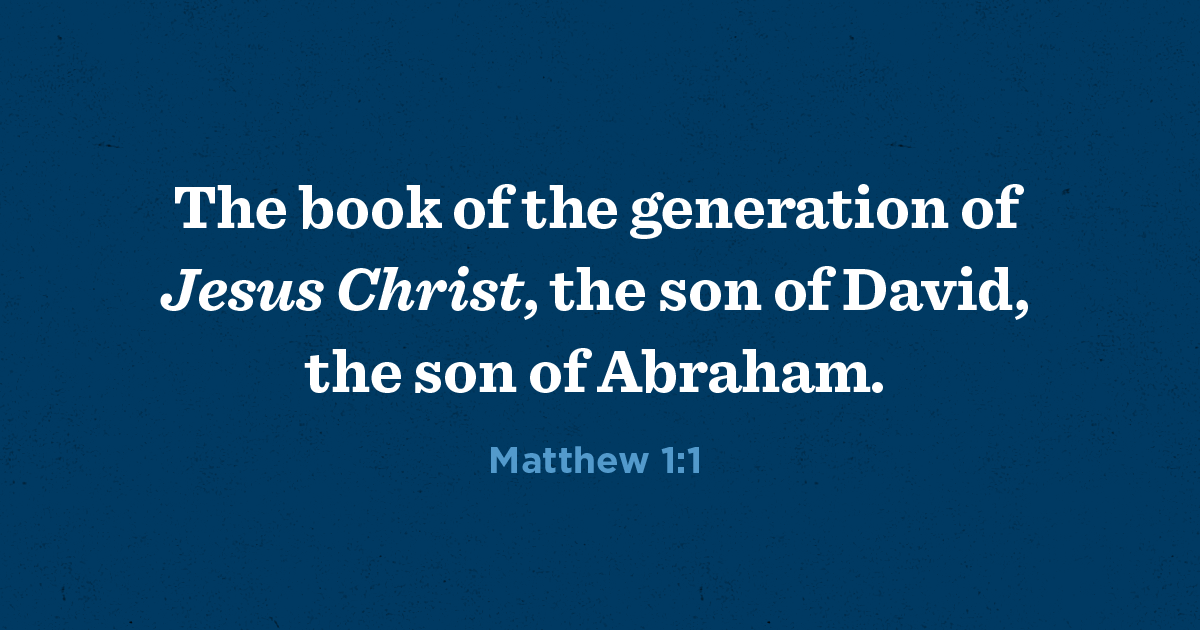
“The book of the generation of Jesus Christ, the son of David, the son of Abraham.”
Why does the New Testament start like this?
Let’s see how the notes in the New Testament Recovery Version can help us.
Note 1 on Jesus in Matthew 1:1 explains:
“The first name and the last name (Rev. 22:21) in the New Testament is Jesus, proving that Jesus Christ is the subject and content of the New Testament.
The Bible is a book of life, and this life is a living person, the wonderful and all-inclusive Christ. The Old Testament gives a portrait, in types and prophecies, of this wonderful person as the Coming One. Now, in the New Testament, this wonderful person has come. The first page of the New Testament, in recommending this wonderful person to us, gives us His genealogy. This genealogy can be considered an abstract of the Old Testament, which in itself is the detailed genealogy of Christ. To understand the genealogy in Matthew, we need to trace the origin and history of every incident.”
This first note on the very first verse in the New Testament helps us to see that Jesus Christ is the subject and content of the entire New Testament. So as we read any book of the New Testament, our major focus should simply be on the person of Jesus Christ. And in His genealogy is a rich revelation of this living, wonderful, and all-inclusive Person.
Now let’s go on to the genealogy. The Recovery Version provides notes on many of the people included in Christ’s genealogy, such as Isaac, Jacob, Rahab, Ruth, David, Solomon, and others. These notes do more than cover historical facts. They shed spiritual light on the history of each person. They enlighten us to know and appreciate the Lord Jesus.
For example, let’s read about Rahab, one of only five women mentioned in the genealogy. Matthew 1:5 says, “And Salmon begot Boaz of Rahab.” Who was Rahab, and why is she specifically mentioned here in Christ’s genealogy?
Note 1 on this verse in the Recovery Version explains:
“Rahab was a prostitute in Jericho (Josh. 2:1), a place cursed by God for eternity (Josh. 6:26). After she turned to God and God’s people (Josh. 6:22-23, 25; Heb. 11:31) and married Salmon, a leader of Judah, the leading tribe (1 Chron. 2:10-11), she brought forth Boaz, a godly man, out of whom Christ came. Regardless of our background, if we turn to God and His people and are joined to the proper person among God’s people, we will bring forth proper fruit and participate in the enjoyment of the birthright of Christ.”
This is a reassuring and encouraging word for us all! No matter what our background is, we sinners have the opportunity to be joined to God’s people and participate in the enjoyment of Christ.
With the aid of the other notes in Matthew 1:1-17, Christ’s genealogy isn’t just a dry list of names but a precious revelation of who Christ is, increasing our love and appreciation for our Lord.
Today we can be the blessed beneficiaries of faithful believers who preceded us. Over the centuries, God opened up the meaning of the Bible to many believers who diligently sought Him in His Word. They in turn conveyed that meaning to others. Over time, what each saw was added to the collective understanding of the Bible.
The New Testament Recovery Version stands on the shoulders of those who went before. With its special features such as the insightful notes, cross-references, and outlines, it can be considered a distillation, or crystallization, of this collective understanding and revelation.
These features certainly do not replace the text of the Scriptures itself. But they do serve to increase our understanding of God’s Word. Here at Bibles for America, we can testify that the Recovery Version has helped us to know and experience Christ and understand the Bible in a way that we never had before. If you live in the US, we encourage you to order a free copy today.
Of course, we definitely should read the Bible consistently so we can become thoroughly familiar with its language and terms. We should also spend time daily to pray with the Word of God for our spiritual nourishment. And whenever we feel like there’s something we don’t understand, we can receive help to be brought into a deeper understanding of God’s Word.
For helpful posts on reading the Bible daily and receiving life from the Word of God, we recommend these:
7 Tips to Build up a Habit of Reading the Bible Daily
7 Compelling Reasons to Read the Bible

The Bible is a precious gift from God. It conveys so much to us, including God’s purpose and way of salvation. As believers, we can’t afford to be unfamiliar with its contents.
In a previous post, we saw that the first, most basic step in understanding the Bible is to read it, cover to cover. This is how we acquire a basic familiarity with the Scriptures that lays the foundation for us to understand God’s Word.
The Bible is a lengthy book. It consists of 39 books in the Old Testament, 27 books in the New Testament, hundreds of chapters, and thousands of verses. Reading through the entire Bible requires our commitment to make it a habit. And even if we’ve already read through the Bible, God’s Word is profound; we need to read it again and again, throughout our whole life.
But how can we develop this healthy and necessary habit?
In this post, we’ll go over seven practical tips to help build up a daily Bible-reading habit.
Amos 8:11 says:
“Indeed days are coming, declares the Lord Jehovah, when I will send a hunger into the land, not a hunger for bread nor a thirst for water, but for hearing the words of Jehovah.”
There may be times when we're not eager to read the Bible. It may sometimes even feel like a burdensome task to complete. When we feel this way, we simply need to ask the Lord to give us a hunger for His Word. We can pray something simple, like:
“Lord, thank You for giving us Your precious Word. Give me a hunger for hearing Your words. Help me build up the habit of reading the Bible daily.”
It helps to schedule a consistent time for reading the Bible. An excellent time is early in the morning, before the busyness of the day begins. We can also read during lunch or before going to bed. No matter when it is, having a designated time incorporates Bible reading into our daily routine.
Perhaps we’ve jumped around in our Bible reading before, reading a passage here or a verse there. We certainly benefit any way we read God’s Word, but it’s hard to read the entire Bible this way. A good strategy is to read book by book, chapter after chapter, without skipping any portion.
And this means we don’t have to spend time deciding what to read each time we open the Bible. We just continue where we left off. As we complete our reading of the Old Testament and the New Testament, we’ll begin to see how cohesive the Bible is.
[[Free Study Bible]]
Every time we come to the Word, it’s good to first turn our heart to the Lord Jesus. The Bible isn’t like a dry, dense textbook. It’s the word of our loving God to us. So even before we start reading, praying a simple prayer like this helps open our heart to Him:
“Lord Jesus, I turn my heart to You right now. Speak to me in Your Word. I’m open to whatever You have to say. Dear Lord, enlighten me as I read today.”
In the course of our reading, a particular verse or phrase may stand out to us. It may comfort us, convict us, or apply specifically to our situation. Other times, a verse may perplex us. Whatever our reaction, when we’re struck by a particular portion we should stop and pray over it.
We can thank the Lord for the comfort, encouragement, or promises we find in His Word. We can also ask Him to show us the meaning of a passage or just talk to Him about a verse.
In this way, the Bible can become a book of prayer to us, leading us to spend time with our dear Lord Jesus and develop an intimate relationship with Him.
It’s helpful to keep track of your progress as you read. You can write down the date you finish a chapter or book in your Bible, or check off each book in the table of contents after you’ve read it. You can also use an online scheduler, an app, or a journal to track your progress.
Keeping track of our progress can be very encouraging. You may not think reading one chapter per day is significant. But if you do this, you’ll finish the whole New Testament in less than a year!
Since reading the Bible is so important, we have to treasure and even guard the time we’ve set aside to enjoy God’s Word. Today, many things can interrupt or distract us. We may tell ourselves we don’t have the time to read the Bible, yet we can spend an hour or more scrolling through social media.
When it’s time to read the Bible, it’s helpful to set your phone to Do Not Disturb so incoming notifications don’t interrupt you. This can help keep you focused on the Word of God.
Some people find that reading the Bible on a phone or tablet is less than ideal because there are so many distractions right there. If you feel this way, try using a print version of the Bible instead to help you focus your whole attention on God’s Word. If you live in the US, you can order a free print New Testament from us here.
A daily Bible-reading habit will lay a strong foundation for our Christian life, increasing our faith and helping us know the Lord Jesus more. May God grant us all a hunger to read His Word!